



How Much Fabric Do I Need? A Complete Quantity Guide
How Much Fabric Do I Need?
Not sure how many metres to order? This guide helps you calculate the right amount for your project — including allowances for seams, hems, fabric width differences, pattern repeats, directional prints, stripes, checks, and nap. For help placing your order by the metre, see our How to Buy Fabric Online by the Metre guide.
Project-by-Project Fabric Quantity Table
These estimates are based on a standard 112–115 cm (44–45 inch) fabric width and a UK size 12–14. Adjust up if you are using a wider or narrower fabric (see the width conversion section below), or if your pattern is larger than a size 14.
| Project | Fabric needed (metres) | Notes |
|---|---|---|
| Tote bag (basic) | 0.5 m | Add 0.25 m for lining |
| Cushion cover (45 × 45 cm) | 0.5 m | Per cover; add extra for piping or flaps |
| Pillowcase (standard) | 0.75 m | Per pillowcase |
| Child's top / blouse (age 2–10) | 1–1.5 m | Use the lower end for younger ages |
| Adult top / blouse (UK 8–16) | 1.5–2 m | Add 0.25 m for long sleeves |
| A-line skirt (knee length) | 1.5 m | Add 0.5 m for a maxi length |
| Midi skirt (calf length) | 2 m | Add 0.25 m for fuller styles |
| Palazzo / wide-leg trousers | 2.5–3 m | Extra for tall heights or wide legs |
| Fitted trousers / jeans-style | 2–2.5 m | |
| Shirt dress (knee length) | 2.5 m | Add 0.25–0.5 m for long sleeves |
| Wrap dress (midi) | 3 m | Generous fabric needed for wrap overlap |
| Maxi dress | 3–3.5 m | Depends on skirt fullness |
| Lined jacket / blazer | 2.5–3 m outer + 2 m lining | |
| Unlined jacket | 2–2.5 m | |
| Coat (knee length) | 3–3.5 m outer + 2.5 m lining | Add 0.5 m for maxi length |
| Single duvet cover (135 × 200 cm) | 4.5 m | Based on 140 cm+ wide fabric |
| Double duvet cover (200 × 200 cm) | 5 m | Based on 140 cm+ wide fabric |
| Curtain drop (per drop, per width) | Drop + 30 cm hem allowance | Multiply by number of widths; add pattern repeat |
| Patchwork quilt top (throw size) | 2–4 m total across fabrics | Depends on block size and design |
| Face mask (set of 5) | 0.5 m | Plus 0.5 m for lining |
Tip: Always add a minimum of 10–15% extra for cutting errors, seam allowances, and shrinkage — especially for natural fibres like cotton and linen that may be pre-washed.
Fabric Width Conversion
Fabric is sold in different widths around the world. If a pattern was written for one width and your fabric comes in another, you will need to adjust the quantity. Use the table below to convert.
| Fabric width | Common use | Multiply pattern quantity by… |
|---|---|---|
| 90 cm (36 in) | Some quilting cottons, craft fabrics | × 1.3 (if pattern is written for 115 cm) |
| 112–115 cm (44–45 in) | Dressmaking cottons, quilting fabric — most common | × 1 (base width) |
| 140–150 cm (54–60 in) | Dressmaking fabrics, coating, furnishing, jersey | × 0.75 (buy less) |
| 280–300 cm (108–120 in) | Specialist curtaining and bedlinen fabric | × 0.4–0.5 (buy significantly less) |
Width conversion example
Your pattern calls for 3 m of 115 cm fabric but you want to use a 150 cm wide fabric:
3 m × 0.75 = 2.25 m — round up to 2.5 m to be safe.
Note: All fabric widths at Bull Ring Fabrics are listed on each product page. The width shown is the usable width excluding selvedges.
Pattern Repeat
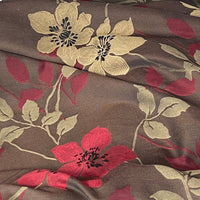
A pattern repeat is the distance before the design repeats itself on the fabric. If your fabric has a large repeat, you will need extra fabric to match the design across seams.
- No repeat (plains, textures): No extra needed.
- Small repeat (up to 5 cm): Add 0.25 m.
- Medium repeat (5–25 cm): Add one full repeat per main pattern piece.
- Large repeat (25 cm+): Add one to two full repeats per pattern piece. For curtains, add one full repeat per drop.
Formula: Round your cut length up to the next full repeat. For example, if your cut length is 1.85 m and the repeat is 30 cm, round up to 2.1 m (i.e., 7 × 30 cm).
Directional Prints
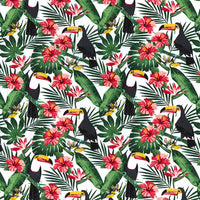
A directional print has a clear "right way up" — florals that all face the same way, animals standing upright, or any design where rotating the fabric 180° would look wrong.
- All pattern pieces must be laid in the same direction.
- You cannot rotate pieces to save fabric.
- Add approximately 15–20% extra over a non-directional version of the same project.
- For garments, use the same metre allowance as you would for nap fabric (see below).
Stripes
Matching stripes across seams gives a professional finish but requires extra fabric.
- Narrow stripes (up to 1 cm): Add 0.25–0.5 m.
- Medium stripes (1–5 cm): Add 0.5 m or one full stripe repeat, whichever is more.
- Wide stripes (5 cm+): Add one full stripe repeat per main pattern piece.
- Bias-cut projects using striped fabric need significantly more — allow up to 50% extra.
Checks and Plaids
Checks must match both horizontally and vertically, which means they need even more care than stripes.
- Treat each check repeat like a pattern repeat — add one full check repeat per main pattern piece.
- For large windowpane checks (10 cm+), add 0.5–1 m over the base requirement.
- Bias-cut check fabrics are very fabric-hungry — allow at least 50% extra.
- When in doubt, add one extra metre and use offcuts for pockets, facings, or bias binding.
Nap, Pile and One-Way Fabrics
Fabrics with nap or pile (velvet, corduroy, fleece, faux fur) must have all pattern pieces running in the same direction — usually with the nap running downward for garments. Brushed fabrics such as flannel and some fleeces also behave this way.
- Use the "with nap" yardage given on commercial patterns.
- If no "with nap" guidance is given, add 15–20% to the base quantity.
- Faux fur with a very long pile may need up to 30% extra due to its bulk and the need to avoid cutting through pile.
- Run your hand along the fabric — nap should feel smooth in one direction and rough in the other. Cut all pieces with the smooth direction running the same way.
Quick Tips Before You Order
- Check the fabric width on the product page and compare it to your pattern requirements.
- Pre-wash natural fibres (cotton, linen) before cutting — allow for up to 5% shrinkage.
- When in doubt, order more — it is cheaper to have a little extra than to run out mid-project.
- Ask us if you are unsure — we are happy to advise on quantities for specific projects.
Ready to order? Find out how to buy fabric by the metre or browse all our fabrics.